Laser therapy of the prostate

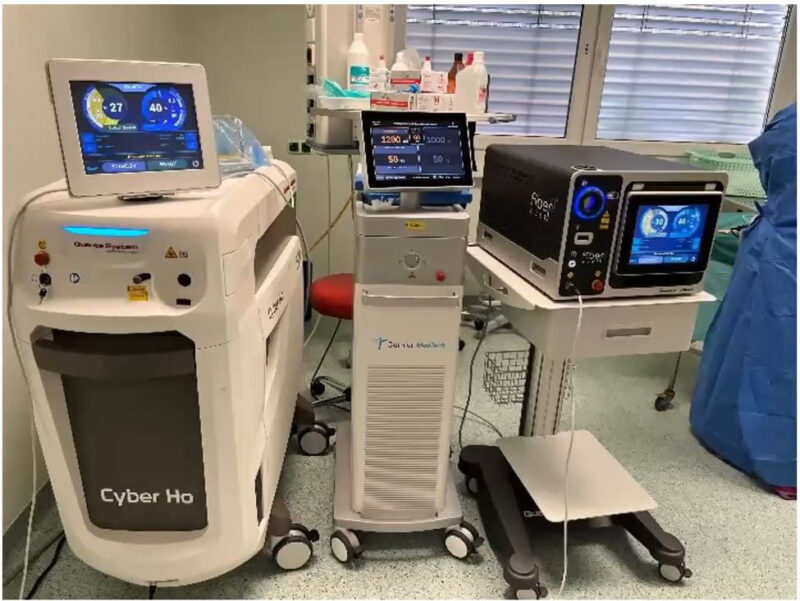
When doctors laser the prostate, they direct a high-energy, focused beam of light at the enlarged prostate gland. Upon contact with the tissue, the laser's light energy takes effect, allowing the excess tissue to be removed outwards at the end.
In this way, surgeons reduce the prostate and relieve pressure on the narrowed urethra. The urination problems – the typical symptoms of an enlarged prostate – decrease after prostate surgery. Laser treatment can be an alternative to TURP for benign prostatic hyperplasia.
Important information:
Laser Therapy
During laser treatment, excess prostate tissue is precisely removed via the urethra using a focused light beam. The aim is to reduce pressure on the urethra and improve urine flow – a minimally invasive alternative to transurethral resection of the prostate (TURP).
Procedure & Suitability
Depending on the size and findings of the prostate, different techniques can be used:
- Holmium Laser Enucleation (HoLEP)
For HoLEP, a so-called pulsed Holmium:YAG laser is used.
The holmium laser operates in the light spectrum at around 2100nm.
The laser precisely separates the prostate tissue, minimising any bleeding.
The procedure speeds up healing and therefore contributes to the shortest possible hospital stay.
- Thulium Laser Enucleation of the Prostate (ThuLEP)
A so-called pulsed Thulium:YAG laser is used in ThuLEP.
The thulium laser operates in the light spectrum at approximately 2013nm.
The laser precisely separates the prostate tissue and simultaneously seals any blood vessels very efficiently.
The laser virtually assists the surgeon with the enucleation.
The procedure speeds up healing and therefore contributes to the shortest possible hospital stay.
Process & Duration
The therapy is performed endoscopically under regional or general anaesthetic. The laser is guided through an endoscope via the urethra; bleeding can be stopped immediately. Duration: approx. 1–2 hours, catheter for a few days; in many cases, short hospital stay.
Effectiveness & Benefits
Studies show a symptom relief on a scale similar to TURP. Advantages of laser therapy: often shorter hospital stays, earlier catheter removal and no risk of the (rare) TUR syndrome.
Frequently Asked Questions
Frequently asked questions in connection with laser surgery
How safe and effective is laser therapy?
Laser therapy (e.g. HoLEP, ThuLEP, PVP/„GreenLight“) is a minimally invasive procedure for benign prostatic hyperplasia (BPH) that has been established for many years. Studies show symptom relief on a scale comparable to TURP; hospital stays and catheterisation times are often shorter. An advantage: The (rare) TUR syndrome does not occur with laser procedures. Overall, the method is considered effective and well-tolerated.
What exactly happens during the therapy?
The procedure is performed endoscopically through the urethra under regional or general anaesthesia. A laser is guided to the prostate via an endoscope; excess tissue is precisely removed, vaporised or „peeled away“ (enucleated). Bleeding can be stopped at the same time. A urinary catheter remains in place for a few days at the end; many patients can leave the hospital shortly after therapy. Laser therapy usually takes 1–2 hours depending on prostate size. Simple rules help with recovery: drink plenty of fluids, do not lift heavy loads, avoid cycling or strenuous exercise for the time being, and avoid saunas/full baths; a sexual abstinence period of approx. 2–3 weeks.
What are the effects of laser therapy?
Temporary irritative symptoms (urinary urgency, burning, slight blood in the urine) are possible and usually subside. Retrograde ejaculation („dry orgasm“) can occur, as with TURP: orgasm is preserved, but the seminal fluid enters the bladder and is excreted with the urine; this can reduce fertility. Incontinence and urinary tract infections are rare and generally temporary.
The laser therapy is suitable for whom?
The choice depends on prostate volume, accompanying conditions and personal goals (e.g., quick return to daily life, tissue gain for histology). Examples: HoLEP shows good results regardless of prostate size; PVP evaporates tissue (advantage: low-bleeding technique, disadvantage: no tissue for histological examination). Your urologist will recommend the appropriate procedure (enucleation, vaporisation, resection or ablation) after individual diagnostics and consultation.
The aim of laser surgery: noticeably easier urination, a short recovery period, and a treatment that fits your priorities.


 Deutsch
 Magyar
 English (UK)