
Benign prostatic hyperplasia (BPH)

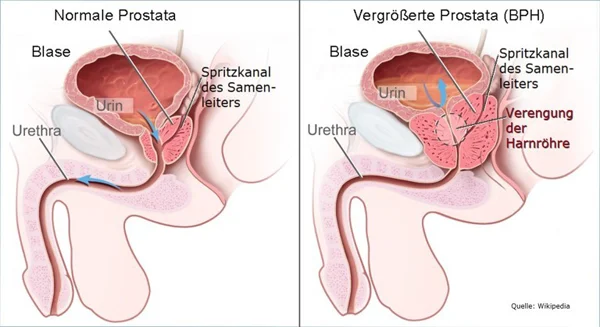
In young men, the prostate gland is approximately the size of a Chestnut or walnut. It surrounds the upper part of the urethra, which runs through the middle of the prostate. The older a man gets, the more the number of prostate cells increases – and with it, the volume of the prostate.
Primarily, those cells of the prostate gland located in the centre around the urethra begin to multiply. This causes the prostate gland to be increasingly pushed outwards. The prostate therefore grows larger and gradually constricts the urethra. You could also say that it is gradually „squeezing the air out“ of it. This usually happens around from the fifth decade of life.
Important information:
Symptoms
The enlarged prostate has consequences for many men. The symptoms caused by benign prostatic enlargement are called Benign Prostatic Syndrome (BPS), Also, benign prostatic syndrome. The word “syndrome” means that men have a whole A bundle of various symptoms developing.
- Frequent and urgent need to urinate (pollakisuria)
- Nocturnal urination - many men also have to get out of bed and go to the toilet at night (nocturia)
- Difficulty starting to urinate ("hesitancy")
- Weak urine stream - the stream is no longer as strong as usual and urination takes longer
- After urinating, there's a dribble of urine.
- The feeling that the bladder is never completely empty
BPH - was bedeutet es genau?
Doctors refer to this condition as benign Enlarged prostate or in medical jargon as Benign prostatic hyperplasia (BPH)). The word “hyperplasia” stands for “Enlargement” and “benign” for “benign”This means that it concerns not about a malignant condition such as Prostate cancer.
Who is affected?
Enlargement of the prostate is very rare in men under 40. However, from the age of 40 onwards, the risk of an enlarged prostate increases continuously, as the following figures show:
- Between the ages of 50 and 59, approximately 20 percent to 45 percent of men have an enlarged prostate.
- In the age group over 70 years, up to 70 percent suffer from benign prostatic hyperplasia.
So, almost all men will experience prostate issues as they get older. However, the number and severity of symptoms don't necessarily depend on the size of the prostate. Some men with a very large prostate, for instance, experience hardly any symptoms.
What stages are there in prostatic hyperplasia?
Doctors refer to this condition as benign Enlarged prostate or in medical jargon as Benign prostatic hyperplasia (BPH)). The word “hyperplasia” stands for “Enlargement” and “benign” for “benign”This means that it concerns not about a malignant condition such as Prostate cancer.
Depending on the severity of the symptoms, doctors divide prostate enlargement into three stages – these are the symptoms that can occur in each stage.
Stadium 1 (Stage of arousal)
Difficulty urinating (dysuria), needing to urinate at night (nocturia), frequent urination, difficulty starting urination, a weak urine stream, and dribbling after urination are typical. However, there is no residual urine left in the bladder.
Stadium 2 Compensated urinary retention
At this stage, the symptoms mentioned above become more pronounced. The residual urine volume is more than 50 millilitres and the capacity of the bladder decreases.
Stadium 3 Decompensation
At this stage of prostate enlargement, residual urine exceeds 150 millilitres. Medical professionals refer to this as an “overflow bladder”. There is a risk of acute urinary retention, impaired kidney function (obstructive nephropathy), and ultimately kidney failure. Without treatment, benign prostate enlargement can lead to permanent damage to the bladder and kidneys. The complications can even become life-threatening.
Therefore, the following applies: Always seek your doctor's advice promptly if you are suffering from one or more of the symptoms mentioned.
Are there risk factors?
The causes of prostate enlargement are not yet precisely known. Doctors suspect that this slow enlargement of the prostate is part of the normal ageing process. This is why age is the most important risk factor for this prostate condition, but not the only one!
Frequently Asked Questions
Frequently asked questions concerning prostate problems.
When should I see a doctor?
In general: Always seek prompt medical attention if you are experiencing one or more of the following symptoms:
- Frequent and urgent need to urinate (pollakisuria)
- Nocturnal urination - many men also have to get out of bed and go to the toilet at night (nocturia)
- Difficulty starting to urinate ("hesitancy")
- Weak urine stream - the stream is no longer as strong as usual and urination takes longer
- After urinating, there's a dribble of urine.
- The feeling that the bladder is never completely empty
What happens at the doctor's?
First, the doctor will ask you about your medical history. The more accurate your information, the better an initial assessment can be made.
Among other things, the following points are important:
- What exactly are your complaints?
- How long have you been suffering from these symptoms?
- How severe are your symptoms?
- Have the symptoms continuously worsened or improved and then worsened again?
- How much do your symptoms affect your daily life?
- Do you have any known pre-existing conditions?
- Do you suffer from urinary incontinence?
- Have you had any operations in the past, particularly in the pelvic area?
- Are there any prostate conditions in your family? Which ones?
- Do you take any medication? If so, which ones and since when?
- What lifestyle do you maintain: diet, sport, exercise, smoking, alcohol?
- How much do you drink and how often do you need to urinate?
- What about sexuality, erections, ejaculation?
- How would you describe your bowel function? Are there any irregularities with your bowel movements?
What can be done for prostate problems?
There are different measures! The most important goal in treating prostate enlargement is to quickly reduce bothersome symptoms and improve quality of life. In the long term, the aim is to slow the progression of prostate enlargement. This means: symptoms should not worsen, the prostate should not continue to grow, and the risk of complications associated with prostate procedures should be reduced.
Is it always operated on?
Doctors fundamentally distinguish between two strategies: Without surgery (conservative) and with operation. They generally recommend prostate surgery when symptoms are severe and significantly affect your daily life and quality of life. Surgical intervention is also recommended if medication is no longer sufficiently effective or if complications arise.
To gain clarity on this, consultation with a specialist doctor is necessary.



 Deutsch
 Magyar
 English (UK)